
REVIEW · ECO TUK-TUK & ELECTRIC CITY TOURS
Christmas Lights Tour of Madrid in Eco Tuk Tuk Private
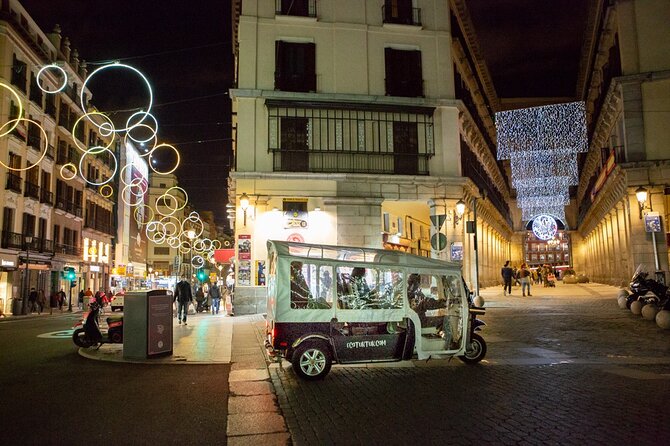
Christmas lights plus a fast, electric ride. It is a slick way to see Madrid glowing up for the holidays, with pre-selected photo stops and no queue start built in. I also like that it is private, so you get a real guide experience without the squeeze.
What really makes it work is the way the route stitches together big landmark names and holiday mood. You will cruise through high-impact areas like Salamanca’s main streets and major city-center squares, while an English-speaking guide adds context as you go, and guides such as Carlos, Ana, David, Laura, and Belén show up often in the guide mix.
One thing to keep in mind: this is a fixed-route, short-duration ride, and the timing can shift if street closures or demonstrations slow things down. Also, if you go on a day when some displays are limited, you may feel the tour is closer to a holiday highlights drive than a full lights crawl.
Key things I’d plan around

- A 59-minute private ride that hits many of the must-see zones without you wrestling with traffic on foot
- 100% electric tuk-tuks plus blankets and rain protection for winter nights
- Photo stops that are set in advance, so you will not be able to swap them around on the fly
- Iconic squares on the route, including Cibeles, Columbus area stops, and key Prado-adjacent spots
- English-speaking guide narration tied to landmark stories, from Ferdinand-era gates to 19th-century monuments
See the centre from a small electric ride
- Madrid Welcome Tour with Local Guide in Eco Tuk Tuk Private★ 5.0 · 2,936 reviews
- Madrid: Private City Tour by Eco Tuk Tuk★ 4.9 · 2,876 reviews
- Madrid Historical Tour with Local Guide in Eco Tuk Tuk Private★ 5.0 · 876 reviews
- Madrid Express Tour with Local Guide in Eco Tuk Tuk Private★ 5.0 · 413 reviews
Electric tuk-tuk comfort for a Madrid night

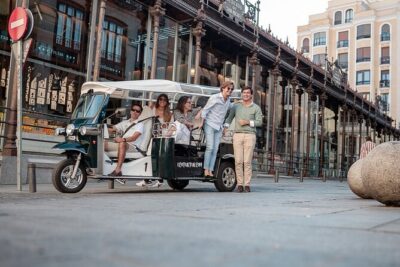
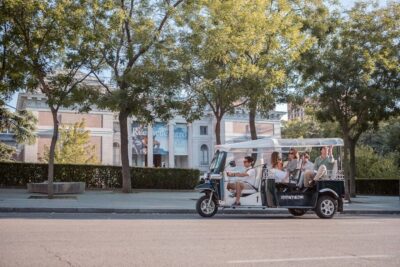
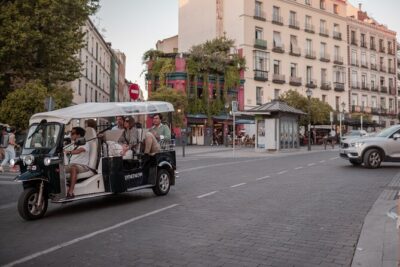
This tour is built around a simple idea: you want holiday lights, but you also want your legs. The ride runs in one of those open eco tuk-tuks, yet in winter you get protective layers against rain and wind and blankets to keep warm. That matters because Madrid nights can go cold fast once the sun drops.
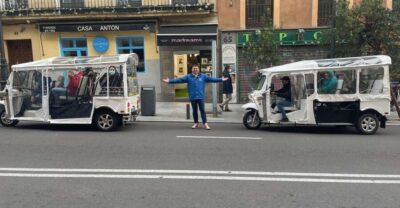
It also helps that the tour is private for your group only. Tuk-tuks have a legal max of 4 passengers per tuk-tuk, so larger groups may use multiple vehicles, but you still get that same controlled, group-only flow. The experience is also designed to start smoothly, with no queues or waiting at the beginning.
The duration is about 59 minutes, which is short enough to stay fun and focused, but long enough for the guide to connect the dots between neighborhoods and monuments. If you want a marathon, this is not it. If you want a holiday sampler that gets you oriented fast, it fits nicely.
Meeting at Antonio Maura, then returning the same way
You meet at C. de Antonio Maura, 13, Retiro, 28014 Madrid, and the tour ends back at that same meeting point. That round-trip setup is practical because it avoids the usual “now what?” feeling after an evening activity.
Because the vehicles are suitable for older people, drivers will help you get on if needed. That is a small detail, but it can make a big difference when you are traveling with anyone who is less steady on their feet.
Also, you should plan to be ready for street-level movement. This is a ride-through experience with set stops for photographing. You will not be hopping on and off randomly, and the route can change due to street closures or demonstrations on the day.
Puerta de Alcalá and the Salamanca streets in light
One of the first big “wow” moments is the monumental gate built by order of Carlos III, replacing an older 16th-century gate, and inaugurated in 1778. Even before you focus on Christmas lighting, this is the kind of landmark that feels made for nighttime views: bold stone lines, strong presence, and easy-to-spot geometry for photos.
Then you shift into the Salamanca neighborhood, cruising along Velázquez, Ortega y Gasset, and Serrano. Salamanca is where Madrid gives you a more polished, upscale rhythm. If the holiday mood is your goal, this part is a good bet because the streets and facades tend to look especially sharp when lit up.
The practical benefit here is that you are not guessing your way through neighborhoods. In under an hour, you get a taste of both classic monumental Madrid and the more elegant street corridor vibe that many people associate with the city.
Another Madrid route worth weighing up
Columbus, Discovery Gardens, and Villa Fernán Gómez
Next up is the area around the monument to Christopher Columbus, presiding over a square where traffic revolves around the fountain center. The sculpture is neogothic, made of white marble, and sits on a carved stone pedestal. It reaches 17 meters, and it was built in 1885 by Jerónimo Suñol, tied to the celebration of the wedding between Alfonso XII and María de las Mercedes de Orleans.
From there, you also pass by the Discovery Gardens, inaugurated in 1970. If you like small texture in big cities, this is a nice quick hit. You can admire sculptures there, including a monument linked to the discovery of America.
And in the basement is the Cultural Center of Villa Fernán Gómez. Even if you do not go inside, having a cultural stop like this in the mix gives the tour more than just lighting spectacle. It makes the city feel lived-in.
If you care about photos, this is one of the stops worth leaning into, since the Columbus monument and the surrounding square can look dramatic with holiday lighting.
The National Library’s museum side, plus 30 million items in spirit
The route includes the National Library of Spain (BNE), an autonomous body that preserves Spain’s bibliographic and documentary heritage. The numbers are the part that stick: it holds around 30 million publications produced within Spain since the beginning of the 18th century, including books, magazines, maps, engravings, drawings, scores, and brochures.
Here is the useful context your guide can bring: the BNE does more than store books. Through the Library Museum and Exhibition Rooms, collections and the library’s functioning and history are shared with the public.
On a one-hour tour, you are not touring the full stacks. But it is still valuable to see where national-scale culture lives. It also helps you understand why Madrid feels like more than postcard landmarks. This stop anchors the city’s identity in preservation and scholarship.
Plaza de Cibeles, Cibeles the goddess, and football devotion

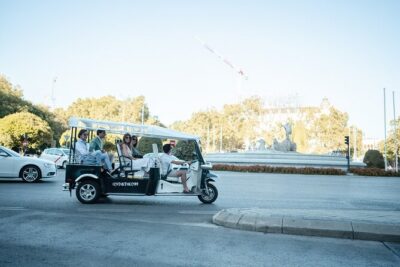
Plaza de Cibeles is the kind of place where the city’s big themes show up fast. You see the fountain with the Roman goddess Cibeles on a chariot pulled by two lions. The mythological story matters here, because the chariot is tied to Hipómenes and Atalanta, and the overall sculpture is split across different sculptors: the goddess is by Francisco Gutiérrez, and the lions are sculpted by the Frenchman Roberto Michel.
The square itself is also surrounded by major civic buildings, including Buenavista Palace (Army Headquarters), Linares Palace (America House), Communications Palace (formerly the post office, now Madrid City Council), and the Bank of Spain. That gives you a quick architectural survey in a single zone.
Then there is the sports layer, and it is not just trivia. Cibeles is an icon for Real Madrid fans, where Madrid titles and Spanish team successes get celebrated. If you visit with anyone who follows football, this stop usually gets extra energy.
Even if you only see it from the vehicle during the photo window, the fountain’s size makes it hard to miss, and the lighting in winter can turn it into a strong holiday focal point.
Palacio de Cibeles and the Post and Telegraph Society story

Another key stop is the Palacio de Cibeles, built as the headquarters for the Spanish Post and Telegraph Society. It was designed and built by Antonio Palacios and Joaquín Otamendi, and inaugurated in 1909. In 1993, it was declared a Site of Cultural Interest with the monument category.
You get a quick explanation of its design logic: rationality and functionality, with the feeling of a union between tradition and modernity. It is constructed using stone, iron, and glass, which is a helpful detail for you to notice visually if you spot the structure while the vehicle rolls by.
If you are the type who likes architecture, this stop pays off because it is not just a pretty facade. It is a signpost for how infrastructure became monumental in early 20th-century Madrid.
Banco de España, Plaza de Canalejas, and civic Madrid vibes

The tour also includes the Banco de España building, described as award-winning and famously ornate. It was built to give the National Bank a headquarters matching the importance of its role, including the single issue of coins and bills across Spain.
One practical note: the interior is limited. It can only be visited by groups from educational centers and universities, and exceptionally by cultural and non-profit associations. So on this tour, treat Banco de España as a street-view landmark. The value is in seeing the scale and learning what sits behind it.
From there, you move toward Plaza de Canalejas, formerly known as Four Streets. It sits in the Centro district between Carrera de San Jerónimo and Calle de la Cruz, Sevilla and Príncipe. This kind of plaza stop is useful on a holiday lights tour because it helps you understand how the city’s movement patterns form at intersections, not just along major boulevards.
The vibe here is civic and central, which pairs well with the festive lighting theme.
Palacio de las Cortes and the iron lions at the entrance
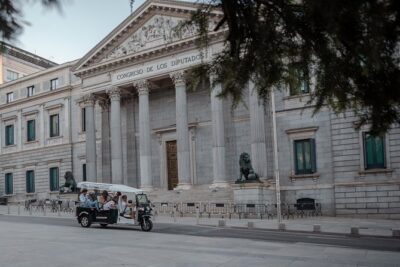
Another highlight is the Palacio de las Cortes, built on the site of the old convent of the Holy Spirit, used as headquarters of the Congress between 1834 and 1841. On the main facade you see a neoclassical portico reached by a staircase, with six Corinthian columns and a triangular pediment decorated with reliefs by Ponciano Ponzano.
The lions flanking the entrance are a standout detail: they were cast from iron from cannons captured during the African War. It is a reminder that many European civic buildings have messy histories stitched into the stone.
Under the pediment, there is a chiseled bronze door that is only opened on very special occasions. On a lights tour, you typically do not see doors open, and that is fine. The architectural lesson still lands, and the exterior is photogenic in winter night lighting.
Neptuno vs. Cibeles, plus the Prado Museum from street level
Your route includes the famous fountain pairing: Cibeles and Neptuno. In Ventura Rodríguez’s original project, the fountains were first facing each other along the Paseo del Prado. Later, at the end of the 19th century, both were restructured and relocated until they occupied the center of Cibeles and Cánovas del Castillo squares.
This stop can feel more like a “city understanding” moment than a single monument moment. You learn how urban planning choices shaped what you see today. On a short tour, that kind of perspective is gold.
Then you reach the Prado Museum area. The museum is described as one of the world’s most important museums for European painting, with an especially strong presence of artists like Velázquez, el Greco, Goya, Titian, and Rubens, plus major collections including Bosch. It also highlights other big names such as Murillo, Ribera, Zurbarán, Fra Angélico, Rafael, Veronese, Tintoretto, Patinir, Antonio Moro, Van Dyck, and Poussin.
On this tour, you should expect this mostly as an exterior landmark and a story stop. If you want to actually enter the museum, you will need separate tickets.
Still, it is worth it. Prado is such a recognizable anchor that even a “pass by with context” stop helps you orient yourself for future Madrid sightseeing.
San Jerónimo el Real: a late Gothic church near the Prado
The tour wraps by passing San Jerónimo el Real, popularly known as Los Jerónimos, with the official name Parish Church of San Jerónimo el Real. It is a late Gothic church with Renaissance influences from the early 16th century.
The name connects it to Spain’s kings. It was built by order of the Catholic Monarchs, and it became a spiritual retreat for several monarchs. It also served as a place for royal investiture in the absence of a cathedral. The wedding of Alfonso XIII took place here too, and the great staircase leading to the church doors was built in 1906.
A lights tour is not usually the time to study architecture like you would in daytime. But this church stop works because it feels ceremonial, and at night the stone and light glow well together. It is also mentioned as a treat during the ride, which makes it one of the moments where the short duration actually feels “worth it.”
How the Christmas lights stops work in real life
This is not a choose-your-own-adventure holiday walk. You get pre-selected stops for photographing, and the tour stops cannot be modified. That means you should show up ready to work with the plan, and plan your expectations: you will get great views, not endless wandering.
Also, the itinerary can vary due to street closures or demonstrations. Madrid can surprise you, especially around major dates. If that happens, your route may shift, but it is still meant to keep the experience moving.
Now the tricky part about Christmas lights: the availability of certain displays can depend on the exact day. One reported experience on Christmas Day noted that some lights were not on, so the night felt more like the city’s festive glow than a full-on lighting show.
To handle that, I suggest you treat this as a quick, high-value overview plus a chance to learn what to revisit later. The route is best viewed as a way to get your bearings and capture a few anchor photos, then decide what you want to explore again.
Price, value, and who this private tour suits best
At $47.77 per person for about 59 minutes, the value is mostly about efficiency and comfort. You are paying for: a private vehicle setup, an English-speaking guide, and the ability to cover a big stretch of central Madrid without standing in the cold or navigating traffic.
You also get winter comfort support built in, like blankets and protective layers. That can be a real money-saver in terms of “do I really want to do this walk tonight?” because it reduces discomfort fast.
It helps that the experience has a strong track record, with a 4.8 rating and about 97% of travelers recommending it. In plain terms, most people leave feeling it delivered.
Who it fits best:
- Families who want an easy first evening in Madrid
- Couples who want a quick holiday highlights loop
- Anyone who dislikes long waits, and wants a guided route with context
- Travelers who want a modern, eco-friendly way to see central Madrid at night
Who might want to look elsewhere:
- If you want long time to stop and linger for photos beyond what is planned
- If your goal is only the most intense lights display, with no compromise
- If you want fully flexible routes and stop swaps
Should you book? My practical verdict
If you want a high-comfort, one-hour Christmas lights orientation in Madrid, this tour is a solid buy. The electric vehicle setup, blankets, and the tightly chosen mix of monumental, civic, and cultural stops make it easier to enjoy the holiday mood without getting stuck in logistics.
Book it if your priority is: get oriented, see the big landmarks lit up, learn what you are looking at, and keep it simple.
I would not book it if you need long photo time, you hate fixed itineraries, or you are chasing a guaranteed every-light-on spectacle regardless of the date. In that case, you might prefer a more flexible walking plan.
FAQ
How long is the Christmas Lights Tour of Madrid in an Eco Tuk Tuk?
The tour lasts about 59 minutes.
Is this tour private?
Yes. It is a private tour/activity, and only your group participates.
What language is the tour guide?
The tour is offered in English.
Where do we meet, and where does the tour end?
You meet at C. de Antonio Maura, 13, Retiro, 28014 Madrid, Spain, and the activity ends back at the meeting point.
Is the tuk-tuk electric and eco-friendly?
Yes. The tour uses a 100% electric and sustainable vehicle.
Does the tour run in rain or cold weather?
The tours take place in rain or heat, and in winter the tuk-tuks have protective layers against rain and wind, plus blankets to keep you warm.
What is included in the price?
Included items are an expert companion guide driver, a start without queues or waiting, a private vehicle for your group only, the electric tuk-tuk, pre-selected stops for photographing, and blankets and protective layers against rain and wind.
Are hotel pickup and tips included?
Hotel pickup and drop-off are not included, and tips to the driver guide are also not included.
Can I bring a pet or companion animal?
No. Pets and companion animals are not allowed for security reasons.
Are there age or weight limits for kids?
Yes. The minimum age is 2 years, babies are not allowed, and there is a minimum weight requirement of 9 kg.
What is the cancellation policy?
You can cancel up to 24 hours in advance for a full refund. If you cancel less than 24 hours before the start time, the amount paid is not refunded.
More Tours in Madrid
More Tour Reviews in Madrid

Electric loops through the centre

Fresh ways to see Madrid
- Tour to Toledo & Madrid CitySight Seeing Tour
- 2-Day Guided Tour to Cordoba and Seville from Madrid
- Private Transfer from Madrid Airport to Madrid Hotels
- Wine Tasting and Flamenco Master Class in Madrid
- Prado Museum and Royal Palace Private Tour in Madrid
- Monastery Royal Barefoot Visit with entrance without waiting for queues
More ways into Eco Tuk-Tuk & Electric City Tours
 ★ 5.0Madrid Welcome Tour with Local Guide in Eco Tuk Tuk PrivateFrom $282,936 reviews
 ★ 4.9Private City Tour by Eco Tuk TukFrom $612,876 reviews
 ★ 5.0Madrid Historical Tour with Local Guide in Eco Tuk Tuk PrivateFrom $28876 reviews
 ★ 5.0Madrid Express Tour with Local Guide in Eco Tuk Tuk PrivateFrom $28413 reviews
 ★ 4.4City Highlights Tuk Tuk TourFrom $94334 reviews
 ★ 4.4Tour Guiado En Tuk Tuk Recorre Avila De La Forma Mas ComodaFrom $10235 reviews
 ★ 5.0Madrid Expert Tour with Local Guide in Eco Tuk Tuk PrivateFrom $28220 reviews
 ★ 5.0Madrid Expert Plus Tour with Local Guide in Eco Tuk Tuk PrivateFrom $28162 reviews
Try another angle on the same itinerary