

REVIEW · AVILA WALLS & MEDIEVAL DAY TRIPS
Ávila: Tour Privado Casco Histórico y Basílica San Vicente
Walls tell stories if you walk them. This private 2-hour walk turns Avila’s medieval sights into a guided story, starting with the towers and walls at San Vicente Gardens and ending at the center around Santa Teresa Square. I love the way the Basilica of San Vicente interior changes your sense of the city the moment you step in, and I love the ramparts start, where you see why Avila looks like a fortress town. One consideration: it’s a fast, compact route, so if you want to linger for a long time at every stop, you might feel a bit rushed.
You’ll cover the key monuments that define this walled city, plus the quieter, more personal spaces tied to famous Avilans. Expect a Spanish live guide, a focused route with entrance to the Basilica of St. Vincent, and a pace built for getting your bearings quickly.
If you’re trying to choose one way to experience Avila’s historic center without guessing, this is a strong option. You’ll walk through major landmarks and still get that medieval feeling, not just photos.
Key highlights worth your attention

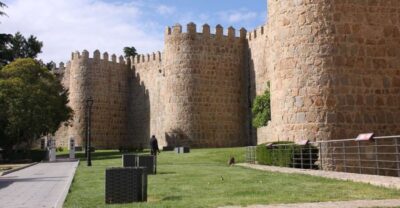
- San Vicente Gardens ramparts start: You begin with the towers and walls that make Avila feel sealed off from the rest of the world.
- Basilica of San Vicente entrance included: The tour includes getting inside, so you experience the light and beauty for yourself.
- Medieval to Gothic to Renaissance stops: You’ll move across styles in a short route, from medieval temple sites to Spain’s early Gothic landmark.
- Cathedral of Christ the Savior tower with dual function: The guide points out why that tall, solitary tower matters.
- Polentinos Palace and the Army museum connection: It’s a 16th-century palace now housing the General Military Archive of Avila and a museum of the Army.
- Santa Teresa sites, tied to the convent area: You’ll connect the birthplace church and Santa Teresa Square to Avila’s most international figure.
Walk the complete walls of Ávila
- From Madrid: Segovia & Avila Day Trip with Optional Tickets★ 4.3 · 2,161 reviews
- Tour Guiado En Tuk Tuk Recorre Avila De La Forma Mas Comoda★ 4.4 · 235 reviews
- TOUR GUIADO EN TUK TUK POR AVILA 1 HORA★ 4.5 · 45 reviews
- Avila: Cathedral Entry Ticket with Audio Guide★ 4.5 · 34 reviews
Setting off from San Vicente Gardens and Avila’s walls

Most people sprint through Avila’s historic center. This tour flips that. You start at San Vicente Gardens, where the guide frames the walls and towers before you even start “doing” monuments.
That matters because Avila’s walls are not just a backdrop. They’re the reason the city feels distinct, cut off, and coherent. Standing at the start, you’re better able to understand what you see later, because you know the walls are the main character.
From there, you transition into a guided walk that keeps bringing you back to how Avila formed across eras. You’re not just checking boxes. You’re learning the “why” behind the arrangement of sites, including the fact that the Basilica of San Vicente sits in an area where many archaeological remains have been found.
Practical tip: wear comfortable walking shoes. Even though the tour is only 2 hours, Avila’s old streets ask for steady footing.
Inside Basilica de San Vicente: light, beauty, and why this spot mattered
The highlight people remember most is the Basilica of San Vicente visit inside. This tour includes the entrance, which is a big deal, because the interior is part of the story, not an optional extra.
What I love about this stop is the way the guide sets expectations before you go in. The Basilica is described as one of the most important medieval temples in Avila, and it’s located in a place with lots of archaeological remains. That combination gives you a sense of layers, like the site has been meaningful across different peoples and cultures that lived in Avila.
Once you enter, the focus turns to the experience of the space itself. The tour highlights the light and beauty of the interior, plus the secrets hidden within its walls. Even if you are not a church-and-architecture expert, you’ll still come away with a clear sense of why this temple is central to Avila’s medieval identity.
Consideration: since it is an interior stop, you’ll want to go in with your senses switched on. Take a moment to look around before trying to capture it on camera, especially if lighting changes affect photos.
Cathedral of Christ the Savior: a first Gothic statement in Spain

Next comes the Cathedral of Christ the Savior, introduced as Spain’s first Gothic cathedral built in Spain. That phrasing alone tells you you’re seeing something important, and the guide helps you read the building like a message.
The big visual is the cathedral’s tall and solitary tower. Here, the tour goes beyond the view and explains the tower’s dual function, which gives you a reason to focus on it instead of just admiring it from below.
Why that helps you as a visitor: towers can look similar in photos across different cities. When someone points out what the tower was designed to do, the building stops being a postcard and starts becoming functional, like the city was planning its skyline and operations in one stroke.
Practical tip: if you’re sensitive to heights or you get tired watching upward views, plan quick looks. The value is in understanding the tower, then moving on before you exhaust yourself.

Polentinos Palace and the General Military Archive museum
The route then shifts to a different side of Avila: its palatial and institutional story. Polentinos Palace is presented as the most beautiful example of Avila’s 16th-century palatial buildings.
The key detail you’ll want to remember is the building’s past job. It used to serve as the academy of quartermaster of the army, and it now houses the General Military Archive of Avila, along with a museum of the Army.
That pairing is what makes this stop more than a façade. You’re not just seeing a historic building. You’re seeing how power, administration, and military organization were housed in real spaces. It also ties nicely to the city’s walls, because Avila’s defensive character and institutional roles belong to the same mental map.
If you like museums but you have limited time, this is a useful compromise. The tour includes the palace stop within a tight 2-hour schedule, so you still get educational context without needing a full museum day.
Consideration: if you are only interested in churches and medieval streets, this palace-museum stop may feel like a change of pace. But it gives you a broader view of what shaped Avila beyond religion.
Santa Teresa’s Birthplace Church and the square where the story continues

Then you enter a more personal kind of sightseeing. Santa Teresa’s Birthplace Church is part of the convent area of the Carmelite monks in the same square, and the guide connects it directly to Santa Teresa as the most relevant and international woman associated with the city.
The tour frames her as an extraordinary character who influenced and transformed not only Avila and Spain of the time, but also crossed borders and became a reference of the Catholic Church. Even if you know the name already, this local focus helps you understand why Avila keeps coming back to her.
After that, the walk ends at Santa Teresa Square, described as a meeting place for locals and visitors. That matters because it shifts you out of the monument mode and back into the everyday urban rhythm. You get a place to pause, regroup, and take in Avila as a living city rather than a set of sights.
From the square, the tour also points you toward the Church of San Pedro, another jewel of the Romanesque Abulense. The mention here helps you spot what kind of architectural language you are seeing in the broader area, even if your entrance time is limited.
Practical tip: if you want photos, this is a good moment. You get architectural detail plus open space, so you can capture the area without crowds being in your way all the time.
Why the route works in just 2 hours

A 2-hour tour sounds short, but Avila is built for walking. This tour is designed to move you through a compact loop that covers walls, a major basilica interior, a Gothic cathedral, a palace connected to archives and the army museum, and Santa Teresa’s sites.
Here’s the value of that design: you get the medieval fortress feeling from the start, then you get key spiritual sites, then you get civic and cultural context, then you end in the center where locals meet. That order keeps you oriented.
Another advantage is the private-group format. For up to 4 people, it feels flexible enough for questions during the walk and helps the guide keep your attention on what matters to you.
One consideration for scheduling: because it is only 2 hours, the pace is efficient. If your dream is slow travel with long sit-down pauses in each church, you might want to pair this with extra time on your own after the tour.
Price and value: what $212 per group up to 4 buys you

At $212 per group up to 4, the cost works out more like a small shared experience than a per-person ticket. For a couple, it can feel very reasonable for what you get: entrance to the Basilica of St. Vincent, a live Spanish guide, and a private route through several major landmarks.
The value equation here is simple:
- You are paying for guided structure, not just access to one site.
- The tour includes the Basilica entrance, so you are not paying extra to get inside the most memorable interior stop.
- You get a private group setting, which usually means less waiting around and more direct attention.
If you’re traveling solo, it may cost more than group-based walking tours, because the price is anchored to the group size. But the payoff can still be worth it if you care about having the guide adjust pacing and focus.
Who should book this private Avila walk
This tour is a good fit if you want:
- A high-impact introduction to Avila’s historic center in a limited window.
- A guided explanation that connects monuments to the people tied to them, including Santa Teresa and the medieval temple significance of San Vicente.
- A mix of places: ramparts and towers, an interior basilica experience, a Gothic cathedral tower focus, and a palace with archive and army museum ties.
It’s especially sensible for:
- Couples or small families who want private attention.
- Travelers who don’t want to build an Avila route alone from scratch.
- Anyone who wants both medieval fortress mood and a few stops that broaden beyond churches.
If you only care about one or two monuments and you’re happy wandering the rest on your own, you might feel this route packs too much. But if you want context, it hits a sweet spot.
Quick practical notes so you enjoy every stop
You meet at Junto a la puerta de San Vicente, which is useful because you can arrive prepared and start without searching.
The guide is Spanish, and the group is private. That combination is ideal for clarity. If you speak basic Spanish, you’ll likely follow even more. If you do not, you can still rely on the guide to point out what to look for at each site, but you may want to focus on the visual cues the guide emphasizes.
Also, this tour is listed as wheelchair accessible. If mobility is a factor for you, it’s worth confirming what “accessible” means in practice for specific street sections, but the accessibility note is a positive sign.
Should you book Ávila: Tour Privado Casco Histórico y Basílica San Vicente?
I think you should book it if you want a straightforward, high-value way to understand Avila quickly. The tour’s strongest advantage is the combination of San Vicente Basilica interior plus a start on the ramparts, so you leave with both mood and meaning, not just photographs.
I would skip it or consider a different option if you want lots of free time inside each stop or you are very sensitive to a brisk pace. This is a focused walk, not a slow museum day.
If you’re traveling in a small group and you care about a guide who keeps explanations structured, this is a smart use of 2 hours. It’s the kind of tour that helps you see Avila like a place with an internal logic, not a checklist of monuments.
FAQ
How long is the tour?
The tour lasts 2 hours.
What language is the live tour guide?
The live tour guide speaks Spanish.
Is this a private group tour?
Yes. It is a private group tour.
What is included with the Basilica of St. Vincent visit?
Entrance to the Basilica of St. Vincent is included.
Where is the meeting point in Avila?
The meeting point is Junto a la puerta de San Vicente.
Is the tour wheelchair accessible?
Yes, the tour is listed as wheelchair accessible.
How much does the tour cost?
The price is $212 per group up to 4.
Can I cancel for a full refund?
Yes. Free cancellation is available up to 24 hours in advance for a full refund.
Can I reserve without paying right away?
Yes. The option reserve now and pay later is available.
More Tours in Avila



More Tour Reviews in Avila


A full circuit of Ávila
More ways into Avila Walls & Medieval Day Trips
 ★ 5.0Avila & Segovia Tour with Tickets to Monuments from MadridFrom $819,762 reviews
 ★ 5.0Three Cities in One Day: Segovia, Avila and Toledo from MadridFrom $1268,402 reviews
 ★ 4.6Avila and Segovia Day Trip with Tickets to MonumentsFrom $744,568 reviews
 ★ 4.5Avila with Walls and Segovia with Alcazar from MadridFrom $603,293 reviews
 ★ 4.3From Madrid: Segovia & Avila Day Trip with Optional TicketsFrom $592,161 reviews
 ★ 5.0Full Day Tour to Avila & Segovia from MadridFrom $601,133 reviews
 ★ 4.6From Madrid: Avila and Segovia Full-Day TourFrom $481,052 reviews
 ★ 4.7From Madrid: Segovia, Ávila, and Toledo Guided TourFrom $991,011 reviews
Try another angle on the same itinerary