

REVIEW · 2-HOUR EXPERIENCES
Tour Madrid in 2 hours! Electric Tuk – Fast, Fun, and Exclusive
Madrid clicks into focus fast. This 2-hour electric tuk tour is a fun, efficient way to see a big stretch of central Madrid without burning time on buses or long walks. I like the speed and the photo-friendly pace, plus the private group format up to 4 keeps it relaxed. One thing to consider: the stops are brief, and the only major paid admission called out is the Palacio Real.
You’ll start at Pl. de la Lealtad in Retiro and zip through classic plazas, royal landmarks, and even big-city sports and shopping zones. It’s a highlights tour, not a slow museum day, so you’ll get context, quick looks, and local flavor notes more than you’ll get deep time inside every site. If you’re coming with high expectations for long entries and lingering, plan to pair this with one or two standalone museum visits later.
Key reasons this 2-hour Madrid electric tuk tour works

- Electric tuk, low-stress touring: You cover ground quickly while still getting out for short, worthwhile moments.
- Private for up to 4: Easier conversation, better photo stops, and less waiting around.
- Most admissions listed as free: You pay attention to sightseeing time, not ticket lines, except Palacio Real.
- Royal Palace area plus old-town core: You get both the official Madrid and the wanderable Madrid.
- Driver and guide service that matters: Reviews highlight strong guiding and even help when timing got messy.
- A good “first-day orientation” route: It’s built to help you map the city fast before you go deeper.
Another Madrid route worth weighing up
- Madrid: 2-Hour Sightseeing Segway Tour★ 4.7 · 217 reviews
- 2-Hour Tour of the Madrid of Mysteries★ 4.5 · 75 reviews
- Madrid Segway: 2h Casa Campo Off Road Tour★ 5.0 · 34 reviews
- 2-Hour Madrid – Prado Museum Private Tour★ 4.6 · 31 reviews
Why a 2-hour electric tuk highlights route makes sense in Madrid

Madrid is spread out enough that your first day can feel like a blur. This tour is built for that exact problem: in about 2 hours, you get a chain of major sights across central neighborhoods, with just enough stop time to orient yourself. The electric tuk helps here. It’s quick, smooth, and you don’t lose the day to transit.
What you’re really buying is momentum. You’ll see landmarks that you’d otherwise stitch together across multiple rides or long walks. And because the group is small and private, the experience tends to feel more like “your route for the next two hours” than a cookie-cutter bus loop.
From Pl. de la Lealtad to the first “Madrid postcard” stops
The meeting point is Pl. de la Lealtad, 1 in Retiro, and the tour ends back there. That round-trip setup matters, because you don’t have to think about navigation or getting stranded across town after a short visit.
Early on, you’ll hit Plaza de Santa Ana in the Cortes neighborhood. It’s an open plaza space dating from the early 1800s, but the bigger value is how it sets the tone. Madrid’s center is all about tight transitions, from official buildings to everyday street life, and that plaza is a quick taste of the city’s rhythm.
Then the route shifts into the royal and cathedral corridor. Even if you only stop for about five minutes at some spots, the guide context helps you understand what you’re looking at, not just where it is.
Royal Palace, Palacio de Oriente: what you’ll see, and what you should budget

The tour includes the Royal Palace of Madrid, also known as Palacio de Oriente. Construction started in 1738, and the palace’s story includes a relocation of royal residence in the mid-1700s. Today, the king’s residence is in another palace, so this one functions mainly for official events and receptions.
Here’s the practical piece: admission is not included. So if you want interior time, you’ll need to add your own entry ticket. If you don’t, you can still enjoy the exterior setting and the lead-in to nearby gardens. Just don’t expect this 2-hour format to turn into a full inside-palace visit.



Almudena Cathedral Museum and the Royal Palace gardens nearby

Next you’ll get a stop at the Museo de la Catedral de la Almudena. The Almudena Cathedral is a major religious building in Madrid, and the museum gathers objects that trace the diocese’s story, spread across multiple rooms. The nice part about including the museum is that you get less “everything looks impressive” and more “here’s how the institution shaped the city.”
Then you’ll pause at Jardines de Sabatini, located in front of the Royal Palace’s north facade. These gardens sit in a small pocket right where the palace dominates the view, which makes them perfect for quick photos. If you like architecture and sight lines, this garden stop gives you a calmer, more scenic moment after the big monumental buildings.
Debod Temple and the shift from monuments to street life

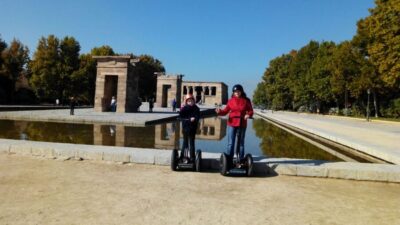
One of the smarter inclusions on this kind of short tour is the Temple of Debod. It’s an Egyptian structure relocated to Madrid, placed on a hill west of Plaza de España. Even if you only have brief stop time, Debod works as a “Madrid curveball,” because it’s not Spanish classic architecture, and it gives your day variety.
Then you move into the old-town engine room: Plaza Mayor. This is the heart of Madrid de los Austrias and the natural starting point for wandering nearby streets. Plaza Mayor’s development is tied to the move of the royal court to Madrid and the push for building uniformity in the 1600s. The value here is not only the square itself, it’s what it helps you do next: mentally map where the charming streets branch off.
Mercado de San Miguel: fast access to Madrid food culture
Right after Plaza Mayor, the tour includes Mercado San Miguel, a covered market with local food and delicatessen in an elegant setting. For a 2-hour tour, this is a smart choice because you can treat it like a food sampler zone, not a full meal commitment.
You’ll typically have enough time for a quick look, maybe a bite, and a sense of what Madrid food culture feels like under one roof. If you’re the kind of traveler who likes to understand a city through taste, this stop earns its place.
Plaza de las Cortes and the Neptune Fountain photo moment
As the tour continues, you’ll see Plaza de las Cortes and the Palace of the Spanish Courts. The building sits on the former Holy Spirit convent site and includes a prominent neoclassical facade with a formal staircase and striking column work. Again, the stop time is short, but the guide context turns the facade into something you can actually place in Spain’s civic story.
Then you reach Neptune Fountain, a neoclassical fountain in the roundabout named for it. Neptune’s fountain was proposed in the late 1700s and built through the 1780s. This is one of those “easy to photograph, easy to miss” Madrid highlights. Even a short stop gives you a landmark you can use later as a reference point when you wander.
The art and royal-prado zone: quick stops, big payoff
Later on, the route reaches the area tied to major European painting. The tour includes a stop for the Prado Museum (focusing on the museum’s famous collection of European masters). Even though your time is brief, you’re still seeing why the Prado has such a global reputation for artists like Velázquez, El Greco, Goya, Tiziano, Rubens, and Hieronymus Bosch. The guide framing matters here, because it helps you choose what to chase if you plan a future museum visit.
From there, you’ll pause at San Jerónimo el Real. It’s often called Los Jerónimos and is late Gothic with Renaissance influences. The church connects to royal ties and royal ceremonies, and it sits in the same zone as the Prado, so it feels like a natural follow-up after the art stop.
Puerta de Alcalá, Las Ventas, and the Madrid that takes itself seriously
One of the most visually dramatic pauses is Puerta de Alcalá. It was inaugurated in 1778 by Carlos III’s mandate and designed by Francesco Sabatini. It’s a neoclassical triumphal gateway and notable for having five openings instead of the typical three. If you like city-scale monuments, this is a must-see on any fast route.
Then comes Las Ventas Bullring, often described as Madrid’s biggest bullfighting arena. It’s the third largest bullring in the world by capacity (with 23,798 spectators listed), and its ring diameter is also among the largest worldwide. Even if bullfighting isn’t your thing, this stop works for architecture fans and for anyone who wants to understand how deeply tradition and public spectacle shaped Spanish city life.
Barrio de Salamanca streets and Santiago Bernabéu: style and sports in one ride
From there, the tour shifts into Barrio de Salamanca, including main streets like Velázquez, Ortega y Gasset, and Serrano. This part is less about one single landmark and more about the vibe. If you want to see the Madrid that feels polished, shopping-centric, and wide-street elegant, this is where you get that feeling without spending hours riding around.
Next you’ll reach Santiago Bernabéu Stadium, inaugurated in 1947 with a current capacity listed as 81,044. Even if you are not a hardcore matchday fan, the stadium’s scale is a reality check. It’s the kind of structure that makes your photos look like you stepped into a different city, because so much of Madrid’s identity is tied to football.
Paseo de la Castellana, Plaza Colón, and the cultural landmarks between
The route travels along the Paseo de la Castellana, linking Salamanca and the stadium area with Plaza Colón. Plaza de Colón centers on the Columbus monument and a fountain with gardens nearby. There’s also a cultural center in the basement mentioned for Villa Fernán Gómez, so the plaza has more going on than the monument view.
Then you’ll reach the National Library of Spain (BNE). The BNE is described as responsible for collecting, cataloging, and conserving Spain’s bibliographic and documentary heritage, with around 30 million publications listed. On a short tour, you can’t fully process a library like a museum, but the inclusion helps you understand that Madrid’s “grand” buildings are not only palaces and churches. They’re also built around learning and record-keeping.
Cibeles Fountain, Banco de España, and the Gran Vía angle
The tour includes Cibeles Fountain, one of Madrid’s most recognizable roundabout monuments. It represents the Roman goddess Cibeles, tied to land, agriculture, and fertility, and it’s pulled by lions. It’s also strongly linked to Real Madrid celebrations, which gives it a social meaning beyond art and myth.
Nearby, the route also passes the Banco de España building. The data notes its purpose, aiming for the national bank to match its importance, including issuance of coins and bills. You likely won’t get broad interior access on this format, but seeing the exterior and understanding what it represents gives you a fuller picture of the city’s institutional power.
Finally, you’ll pass through Gran Vía, one of Madrid’s main streets built in the early 1900s. It’s a key part of Madrid’s commercial, tourist, and leisure story, and it’s also a helpful way to connect the route back to the city’s center energy.
Tour pacing, guide style, and the best way to use your 2 hours
This is a high-speed highlights tour. Many stops are in the five to ten minute range, so your success depends on how you approach it.
I recommend you treat it like a curated orientation walk you can ride, then use what you learn to pick your next deeper visit. For example, if a palace exterior pulls you in, plan a separate half-day for the interior. If the art area excites you, schedule time at the Prado later when you can actually sit with paintings.
The guide component is a real part of the value. Reviews praise strong guiding and even extra local insight about Madrid cuisine, plus excellent photo help. One review specifically calls out a driver named Tadeo and praises the guide as also serving as a strong photographer. Another highlights a guide named Ángel, described as friendly, informative, and very helpful with pictures.
That also points to a practical check: confirm the language you want. One negative experience described a language mismatch, where the guide spoke only Spanish even though an Italian guide was expected. If language is important for you, double-check during booking so the experience matches your needs.
Price and value: what you get for about $215 per group
The price is $215.07 per group, up to 4 people, for about 2 hours. That’s not “cheap like public transit,” but it’s also not a full-day private driver rate. For many families and small friend groups, the math works because you share the cost across four people.
The big value lever is that the tour is built around multiple free admission stops (many stops list admission as free, like Almudena Cathedral Museum, Sabatini Gardens, and several plaza or exterior landmarks). The one major paid item called out is the Palacio Real, where admission is not included. So you can choose to keep costs down by skipping interior time, or add that ticket if the inside matters to you.
Also, because it’s private and uses an electric tuk, you’re paying for time saved and for the guide’s “where to look and why it matters” explanations. That’s hard to replicate when you self-tour.
Who should book this tour, and who should skip it
I think this tour is a great match if you:
- Are visiting Madrid for the first time and want a fast city map
- Prefer short stops and photos over long museum sessions
- Want a small private group experience rather than a large bus group
- Like mixing famous monuments with more everyday stops like Mercado San Miguel
I’d skip it, or at least pair it carefully, if you:
- Want deep time inside major sites like the Royal Palace
- Have strict language requirements and haven’t confirmed it for your booking
- Are easily frustrated by missed timing. One review describes a late tuk and lots of phone calls to get the pickup sorted. If your schedule is tight, build in a little buffer.
FAQ
How long is the Madrid electric tuk tour?
The tour lasts about 2 hours.
What is the price and group size?
It’s priced at $215.07 per group, with a maximum of 4 people.
Where does the tour start?
It starts at Pl. de la Lealtad, 1, Retiro, 28014 Madrid, Spain.
Is this tour private?
Yes, it’s a private tour/activity, and only your group participates.
What language is the tour offered in?
The tour is offered in English.
Is the Royal Palace ticket included?
No, admission to Palacio Real is not included.
Are tickets for other stops included?
Many stops list free admission, based on the provided tour details.
Do you provide a mobile ticket?
Yes, the tour includes a mobile ticket.
Should you book this Madrid electric tuk tour?
If you want a fast, well-paced way to see major highlights in two hours, I’d book it. It’s especially good for first-timers who need a quick map of royal Madrid, old-town plazas, art territory, and even the big stadium-and-shopping side of the city. Just go in knowing it’s brief at each stop, and if you care about interiors, plan to add Palacio Real or the Prado later with your own time.
More 2-Hour Experiences in Madrid


More Tours in Madrid



More Tour Reviews in Madrid

Fresh ways to see Madrid
- Tour to Toledo & Madrid CitySight Seeing Tour
- 2-Day Guided Tour to Cordoba and Seville from Madrid
- Private Transfer from Madrid Airport to Madrid Hotels
- Wine Tasting and Flamenco Master Class in Madrid
- Prado Museum and Royal Palace Private Tour in Madrid
- Monastery Royal Barefoot Visit with entrance without waiting for queues
More ways into 2-Hour Experiences
 ★ 4.72-Hour Sightseeing Segway TourFrom $50217 reviews
 ★ 4.52-Hour Tour of the Madrid of MysteriesFrom $1475 reviews
 ★ 5.0Axe Throwing 2 Hour SessionFrom $3349 reviews
 ★ 5.0Madrid Segway: 2h Casa Campo Off Road TourFrom $7234 reviews
 ★ 4.62-Hour Madrid – Prado Museum Private TourFrom $30631 reviews
 ★ 5.0Ax Throw – 2h – PREMIUMFrom $3325 reviews
 ★ 4.62-Hour Private City Tour Off the Beaten TrackFrom $8922 reviews
 ★ 4.92-Hour Private Off-Road Segway Tour of Casa de CampoFrom $6320 reviews
Try another angle on the same itinerary