

REVIEW · ECO TUK-TUK & ELECTRIC CITY TOURS
Tour en tuk-tuk electrico por MADRID MODERNO
Madrid in one ride feels oddly effortless. This electric tuk-tuk loop strings together big-name landmarks and city-changing neighborhoods, with a guide who keeps the story moving. You get an efficient way to get your bearings fast, without the constant stop and start of walking.
I especially like the photo-stop style, where you can pause, snap, and still hear just enough context to make each spot click. Second, I like the small-group feel of a private tour, which makes it easier to match the pace to your questions and comfort.
One consideration: there have been a few reports of drivers or guides not showing up on time, so you should confirm day-of and plan to communicate if anything feels off. Also, heavy traffic can make hearing the guide a little tricky.
Key highlights you will feel right away

- Private electric tuk-tuk, up to 4 people, so you are not squeezed into a crowd.
- A perfect first-day Madrid route, pairing palace-and-cathedral landmarks with modern streets.
- English guides who keep it lively, with repeat mentions of fun, patient guiding.
- A smart mix of architecture types, from neoclassical fountains to the Prado area.
- Photo breaks that stay efficient, so you see more than you can on foot in 90 minutes.
See the centre from a small electric ride
- Madrid Welcome Tour with Local Guide in Eco Tuk Tuk Private★ 5.0 · 2,936 reviews
- Madrid: Private City Tour by Eco Tuk Tuk★ 4.9 · 2,876 reviews
- Madrid Historical Tour with Local Guide in Eco Tuk Tuk Private★ 5.0 · 876 reviews
- Madrid Express Tour with Local Guide in Eco Tuk Tuk Private★ 5.0 · 413 reviews
How the electric tuk-tuk route covers modern and classic Madrid fast

This tour is built for momentum. In about 1.5 hours, you bounce through royal Madrid, historic churches, major museums, and the city’s showpiece avenues. The tuk-tuk format matters here. You get the thrill of movement and the comfort of not constantly climbing stairs or weaving through crowds on foot.
The route also does something smart: it balances big icons with places that show how Madrid functions day-to-day. A stop near Atocha brings you right into the rhythm of a major transit hub, and the time spent around Gran Vía and Salamanca gives you a feel for modern Madrid’s energy and shopping streets.
You will also notice that most stops are short. That is not a weakness. It is the design. You get enough to understand what you are looking at, then you can decide later what deserves a return visit.
Price and value: what you pay per person
The price is $131.54 per group, up to 4 people, for about 1 hour 30 minutes. If you split it four ways, you are effectively paying around $33 per person. If it is just two of you, it becomes closer to $66 per person.
That pricing makes the tour most valuable when you travel in a small group, or when you want an organized highlights run before you explore on your own. It is less of a bargain for solo travelers, but still can be worth it if you want a guided orientation without committing the whole day to museum tickets.
On average, this tour tends to be booked about 119 days ahead, which tells me you should lock it in early, especially if you are traveling in peak seasons.
Meeting point and timing, and why 9:00 am matters
The tour meets at C. de Vergara, 1, Centro, Madrid, starting at 9:00 am and ending back at the same place. The early start is practical. It helps you beat the worst of the morning crowds around central landmarks and gives you daylight for photo stops.
You also get a mobile ticket, and you will have a private group experience. That usually makes the whole thing feel smoother than a large shared tour, because your guide can keep track of your group’s pace and questions.
One thing I recommend: if you have any flexibility, arrive a few minutes early and stay within the meeting area. Some service issues are reported, and the faster you confirm you are at the right place, the easier it is to fix problems fast.


Royal Palace and Almudena: where power meets architecture
The tour starts with two of Madrid’s biggest symbols of authority and faith, and it does a good job setting tone.
Royal Palace of Madrid
You stop at the Royal Palace, the official residence of the King of Spain. It is enormous, 135,000 square meters with 3,418 rooms, and it is described as the largest royal palace in Western Europe. The scale is the point. Even if you never buy a ticket inside, standing outside gives you a real sense of why Madrid was built to impress.
A practical note: because the stop is short, plan to focus on the exterior views that catch the light. If you want the full interior experience later, this is the stop that tells you whether you will care to return.
Almudena Cathedral
Next comes Almudena Cathedral, dedicated to the Virgin Mary under the invocation of Almudena. It sits in the historic center, built on the site of an older mosque, and the name traces back to the Arabic word al-mudayna, meaning citadel. The building’s style mix is one of its coolest features: neoclassical on the outside, neo-gothic inside, and neo-romanesc in the crypt.
If you are the type who likes architecture, Almudena is a win because it is a visible timeline of Madrid changing over centuries. The drawback is that you do not get long enough here to linger deeply. But as an orientation stop, it is strong.
San Francisco el Grande, Puerta de Toledo, and the city’s roundabout moments
This stretch feels like a tour of Madrid’s “in-between” spaces, the ones you normally pass without noticing.
Royal Basilica of San Francisco el Grande
You visit San Francisco el Grande, also called Basilica of Our Lady of the Angels. The church presides over the western face of Plaza de San Francisco, and it connects to a Franciscan convent founded in the early 1200s. Even during a quick stop, it is easy to see how the basilica anchors the square.
The best way to enjoy this stop is to look at the building’s relationship to the plaza. This is not just a church. It is a focal point in the neighborhood fabric.
Toledo Gate (Puerta de Toledo)
Then you roll by Puerta de Toledo, a historic access gate to the city. The current gate dates to the first third of the 19th century, designed by architect Antonio Aguado, and it was erected as a triumphal arch honoring King Ferdinand VII after Spanish independence following the French occupation.
Because it is located in the middle of a roundabout, you often see it while traffic flows. That is exactly why the tuk-tuk helps. You get a guided explanation right when your eyes are on it, so the meaning sticks instead of slipping away.
Neptune Fountain
Finally, you reach the Neptune Fountain in Plaza de Cánovas del Castillo. Proposed in 1777, construction started in 1782 and finished in 1786. It was originally located at the descent of the San Jerónimo race, facing the Cibeles fountain, then moved to its current central position in 1898.
This is one of those stops where the guide’s context makes the fountain feel like more than decoration. If you love city design, you will like seeing how landmarks were rearranged as Madrid’s urban plan evolved.
Atocha and Reina Sofía: transit, then modern art

This part of the ride shifts gears from monuments to Madrid’s daily engine, then into 20th-century art.
Atocha Station
Atocha is a railway complex and a junction, and it is described as the busiest station in Spain in terms of passenger traffic. It began as a simple halt in 1851 and expanded over time, becoming a more major station by 1892.
Even if you never ride the trains, the value is in what you learn visually: Madrid is not only palaces and museums. It is movement. Atocha shows that the city functions through infrastructure as much as through architecture.
Museo Reina Sofía
Then you head to Reina Sofía, one of Spain’s major modern and contemporary art museums. It uses the old General Hospital of Madrid as its headquarters, including the Sabatini building, and later expanded with the Nouvel building in 2005.
If you want a museum day later, this quick stop works like a teaser. You get the location and the feel of the area, then you can decide whether to book more time. In a 90-minute highlights tour, Reina Sofía is best treated as a “set the target” moment.
Jerónimos and El Retiro in short bursts
You get a concentrated look at the Retiro area, including stops tied to major museums and historic royal spaces.
Jerónimos
You stop near the old monastery of San Jerónimo el Real, known as Los Jerónimos. Your guide gives you brief details, and this stop has free admission noted for the time there. It is a good pause because it breaks the museum pace with something more religious and solemn.
Casón del Buen Retiro
Next is Casón del Buen Retiro, one of the surviving buildings from the former Buen Retiro Palace. It was built in 1637 as a ballroom space for Felipe IV’s court. Since 1971 it has been part of the Prado Museum complex. It used to house a lot of 19th-century collections and also Picasso’s Guernica before that painting moved to Reina Sofía in 1992. The Casón reopened later as a museum study center in 2009.
Even with a short stop, the story helps. This is where Madrid’s art world ties into royal history, and where you can see how spaces get repurposed as tastes and institutions change.
Salón de Reinos
The Salón de Reinos is another powerful named stop. It was the representative axis of the old Buen Retiro Palace, built between 1630 and 1635. The room gets its name from the coats of arms of the 24 kingdoms of the Hispanic Monarchy painted there during Philip IV’s time. It later housed the Army Museum for many years, from 1841 to 2005, before the collections moved to the Alcázar of Toledo.
Why this matters for you: it is a fast lesson in how Madrid keeps reusing impressive rooms for new purposes. If you like museums, you will appreciate the way these spaces evolved.
Real Academia Española and the Prado Museum zone

This is the “serious culture” stretch, and the tour keeps it efficient by treating it like a sampler platter.
Royal Spanish Academy (RAE)
You stop at the Royal Spanish Academy, a publicly funded cultural institution in Madrid. It was founded in 1713 at the initiative of Juan Manuel Fernández Pacheco, VIII Marquis of Villena and Duke of Escalona. King Felipe V approved it, and statutes came in 1715.
This stop has admission marked as not included, and it is listed as a short visit. Think of it as a quick orientation to an institution that shapes Spanish language standards, not as a deep museum experience.
Museo Nacional del Prado
Then you hit the Prado Museum area, where the museum is described as one of the world’s most important and among the most visited in Spain. It is especially known for paintings from the 15th to the 18th centuries, with major highlights including Velázquez, El Greco, Goya, Titian, Rubens, and Bosch. The stop has free admission noted for the time there.
This is an ideal pairing on a tuk-tuk day. Even if you do not go in, you leave understanding why the Prado is treated as a must. If you do decide to return later, you will know where to aim.
Puerta de Alcalá, Las Ventas, and the Salamanca luxury test drive
After palaces, cathedrals, and museums, the ride swings toward Madrid’s public identity, sports spectacle, and upscale shopping.
Puerta de Alcalá
You stop at Puerta de Alcalá, one of Madrid’s five old royal gates. It sits in a roundabout at Plaza de la Independencia, connecting key streets and near the Retiro gates. Even if you only spend a moment, it is a classic photo landmark that tells you how the city used to grow through formal entrances.
Las Ventas bullring
Next is Las Ventas, the largest bullring in Spain. It holds 23,798 spectators and is described as the third largest in the world, after those in Mexico and Valencia (Venezuela). It is also noted as the second largest by diameter at 61.5 meters.
If you care about Spanish traditions and public architecture, you will like this stop. If you do not, it still provides a clear look at how Madrid stages major events in a monumental setting.
Barrio de Salamanca
Then you spend time in Barrio de Salamanca, about 20 minutes in the plan. This district is named after José de Salamanca y Mayol, Marquis of Salamanca, who promoted and built parts of it in the 19th century. Today, it is one of Madrid’s most important commercial areas and known for luxury shopping around Serrano, Claudio Coello, and Ortega y Gasset streets.
This is a good “what Madrid feels like today” block. Salamanca gives you a more modern, consumer-focused side of the city than the museum quarter.
Plaza de Colón, the National Library, Cibeles, and the Bank of Spain viewpoints
This section is about Madrid’s big civic spaces, where you can see how the city presents itself.
Plaza de Colón
You stop at Plaza de Colón, where streets like Goya, Génova, and Paseo de la Castellana meet. The plaza is named after Christopher Columbus, and there is a neo-gothic monument to him. This is a useful photo break because it is open and easy to orient yourself in.
National Library of Spain
Then you pass the National Library of Spain, which is responsible for deposit, cataloging, and preservation of Spain’s documentary heritage. The number shared is around 30 million publications. This kind of institution does not always get a spot on highlights tours, so it is a nice change of pace.
Cibeles Fountain
You stop at Cibeles, a monumental fountain in Plaza de Cibeles. It was part of a 18th-century urban remodeling plan initiated by King Carlos III, with mythological sculpted motifs suggested across the area. The place was known as Salón del Prado, and it quickly became popular.
The reason this stop works on a tuk-tuk tour is simple: the fountain is a meeting point and a landmark. You can actually use the mental map you build here for the rest of your visit.
Bank of Spain
You also see the Bank of Spain headquarters area. The bank was founded in 1782 by Carlos III. The main headquarters was built between 1884 and 1891 at the confluence of Calle Alcalá and Paseo del Prado, overlooking Plaza de Cibeles.
Even though this is a quick stop, it helps you connect the aesthetics of the plaza to institutions that shaped Spain’s modern economy.
Gran Vía: your final street-level hit of Madrid
You end with Gran Vía, Madrid’s major boulevard-like street, running from Calle de Alcalá to Plaza de España. It was constructed in the early 20th century and is famous for shopping and theater, with a cinema history that some call the Madrid Broadway between Plaza de Callao and Plaza de España.
The stop is about 10 minutes, so keep your expectations clear. This is the last taste, not the meal. Use it to decide where you want to walk next, or where you want to duck into a café.
What to expect from the guides, based on real experiences
The strongest praise across the feedback centers on guiding quality. Names that come up include Juan and Jimena for knowledge and patient, friendly guidance, and Javier, José, and George for making the route enjoyable and understandable in English. Omar Zaman is mentioned in connection with a memorable tour, and José and Javier get credit for courteous service plus good restaurant suggestions.
There is also one practical caution: traffic can overpower a guide’s voice, and audio equipment may not always be perfect. If you are sensitive to sound, I suggest choosing seats where you face the guide and keeping your expectations realistic on busy streets.
Who this tour is best for
You will likely enjoy this tour if you:
- Are short on time and want to see a wide spread of highlights without cramping your feet.
- Want a guided orientation before booking museum tickets on your own.
- Travel as a small group, ideally up to 4, to get the best value per person.
- Prefer learning in short bursts, with photo stops that do not trap you in one place too long.
You might reconsider if you:
- Need long museum time, since most stops are brief.
- Are easily thrown off by scheduling problems, based on the few reports of drivers or guides not arriving as expected.
Should you book this modern Madrid tuk-tuk highlights tour?
I think you should book it if you want a smart, efficient first look at Madrid that mixes the big classics with modern streets like Gran Vía and the Salamanca shopping district. The group pricing works best for two to four people, and the private feel makes the stops feel tailored rather than rushed.
I would not book it blindly on faith alone. Because a small number of people reported a no-show problem, confirm everything the day before, then check in close to the start time. If you do that, this can be a fun way to get your bearings fast and walk away with clear ideas for what to explore next.
FAQ
FAQ
Is this tour private or shared?
This is a private tour/activity, so only your group participates.
How long is the electric tuk-tuk tour?
The duration is about 1 hour 30 minutes.
Where does the tour start and end?
It starts at C. de Vergara, 1, Centro, 28013 Madrid, Spain, and it ends back at the meeting point.
What time does the tour start?
The start time is 9:00 am.
What language is the tour offered in?
The tour is offered in English.
How many people are in a group?
The price is per group, up to 4.
What is included in the price?
Bottled water and the guide/driver are included.
Are museum or attraction tickets included?
Some stops note free admission, while at least one stop indicates admission ticket not included. The tour is set up so you can also choose to just take pictures and listen briefly.
Are tips included?
Tips are not included.
Do I need good weather for this experience?
Yes. This experience requires good weather. If it is canceled due to poor weather, you will be offered a different date or a full refund.
Can I bring a service animal?
Service animals are allowed.
More Tours in Madrid



More Tour Reviews in Madrid
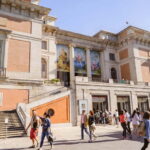

Electric loops through the centre




Fresh ways to see Madrid
- Tour to Toledo & Madrid CitySight Seeing Tour
- 2-Day Guided Tour to Cordoba and Seville from Madrid
- Private Transfer from Madrid Airport to Madrid Hotels
- Wine Tasting and Flamenco Master Class in Madrid
- Prado Museum and Royal Palace Private Tour in Madrid
- Monastery Royal Barefoot Visit with entrance without waiting for queues
More ways into Eco Tuk-Tuk & Electric City Tours
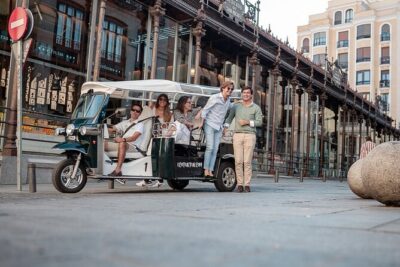 ★ 5.0Madrid Welcome Tour with Local Guide in Eco Tuk Tuk PrivateFrom $282,936 reviews
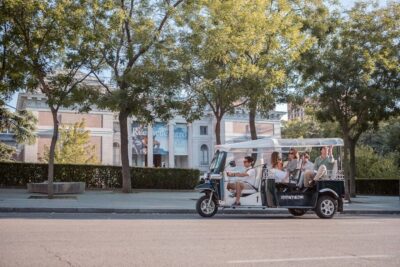 ★ 4.9Private City Tour by Eco Tuk TukFrom $612,876 reviews
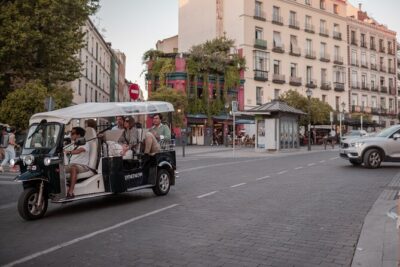 ★ 5.0Madrid Historical Tour with Local Guide in Eco Tuk Tuk PrivateFrom $28876 reviews
 ★ 5.0Madrid Express Tour with Local Guide in Eco Tuk Tuk PrivateFrom $28413 reviews
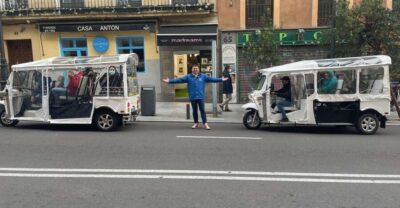 ★ 4.4City Highlights Tuk Tuk TourFrom $94334 reviews
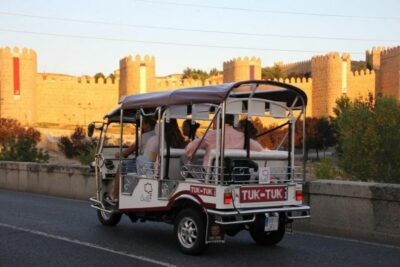 ★ 4.4Tour Guiado En Tuk Tuk Recorre Avila De La Forma Mas ComodaFrom $10235 reviews
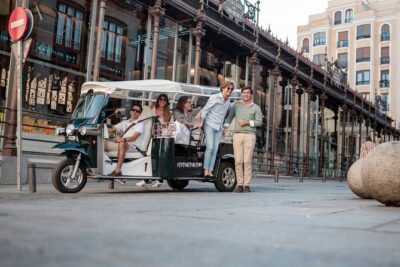 ★ 5.0Madrid Expert Tour with Local Guide in Eco Tuk Tuk PrivateFrom $28220 reviews
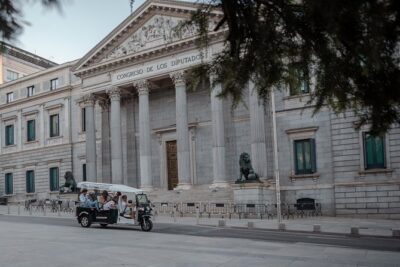 ★ 5.0Madrid Expert Plus Tour with Local Guide in Eco Tuk Tuk PrivateFrom $28162 reviews
Try another angle on the same itinerary