

REVIEW · SEGOVIA & ALCAZAR DAY TRIPS
Three World Heritages Sites – Toledo, Segovia and Ávila Private Tour from Madrid
Three UNESCO cities, one fast day. You get Toledo, Segovia, and Ávila in a single outing, with smooth hotel pickup so your brain stays on sightseeing. I like the way the route mixes big monuments with quick photo stops, plus a guide who keeps the day moving without rushing you out the door.
The one catch is simple: you cover a lot in about 10 hours. If you hate long driving days or need lots of time to linger, you may feel like the day moves quickly.
Key highlights to watch for
- Mirador del Valle for Toledo photos: the best broad view before you start walking.
- Roman roots in Toledo: Puente de Alcántara and the older bridge story.
- Segovia in one skyline: aqueduct, Plaza Mayor, Cathedral, and the Alcázar area.
- Avila wall viewpoints: Los Cuatro Postes and Mirador de la Pradera de San Marcos.
- Tickets you might pay on your own: Alcázar of Segovia and Catedral de Ávila are not included.
- Real flexibility from your guide: guides such as Khan have been described as prompt, accommodating, and quick to adjust.
Take the road south to Toledo
- Three Cities in One Day: Segovia, Avila and Toledo from Madrid★ 5.0 · 8,402 reviews
- Madrid: Segovia and Toledo Tour, Alcazar, and Cathedral★ 4.7 · 7,797 reviews
- Toledo Tour from Madrid: Cathedral, Synagogue & St. Tome’s Church★ 5.0 · 6,784 reviews
- Toledo Half or Full Day Tour with Optional Lunch from Madrid★ 4.5 · 5,807 reviews
Why Toledo, Segovia, and Ávila work so well as a day trip

Toledo, Segovia, and Ávila each feel like a different chapter of Spain. Toledo leans into layers, where Roman traces, medieval streets, and big faith landmarks sit close together. Segovia gives you a classic picture of what Spain looks like on postcards, with the Roman aqueduct and a fortress on a hill. Ávila is the wall city, where the medieval ramparts do most of the storytelling for you.
What I like about this tour format is that it treats the day like a practical route, not a checklist. You get short timed stops at major “you are here” landmarks, then longer blocks inside the historic cores where the atmosphere actually sinks in. If you only have a limited time window in Madrid, this is one of the most efficient ways to hit three UNESCO towns without hiring separate transport for each.
Hotel pickup and private timing, so you do not lose the day

This is a private tour for your group, with hotel pickup and drop-off in Madrid. That matters more than it sounds. You avoid the public transit puzzle, you reduce early morning stress, and you start the day with fewer time drains.
The most useful practical detail here is that your guide can steer the pacing based on your party. In previous groups, the guide experience has included real responsiveness, like adjusting the amount of walking for someone with a walking disability, or building in small comfort moves (umbrellas when rain showed up, and extra time to take pictures). You should still assume it is a full-day loop, but you will not feel like you are stuck doing one fixed path no matter what.
Toledo from the viewpoints first: Mirador del Valle to Puente de Alcántara
Toledo often overwhelms you at street level, because everything looks old and important. The smartest move is getting your bearings early. You start at Mirador del Valle, a valley viewpoint where the city sits in layers, with bridges and the curve of the river shaping the scene. It is a quick stop, but it sets the mental map for everything that follows.
Then comes Puente de Alcántara, widely known as the oldest bridge in Toledo, with Roman foundations. Even if you only take a few minutes, standing there helps you connect the present city to its older engineering roots. You are also positioned to understand why Toledo’s geography mattered so much for trade and defense.
Right after that, you do another bridge stop at San Martín Bridge, on the western side. You get short “photo and orientation” moments at each landmark so you see the city from multiple angles before you go deeper into the streets.
Pair Segovia's aqueduct with its Alcázar
Toledo’s medieval center: Zocodover, Cathedral area, and Santo Tomé
Next you move into the medieval heart. Plaza de Zocodover is a great example of a place that feels like it has always been central. It traces back to the Arabic occupation, and today it still acts like a hub where people naturally converge.
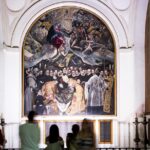
After that, you get time in Casco Histórico de Toledo, typically with a couple of anchor stops that help you decode what you are looking at. You may pass by the Santa María Cathedral area, and you also get the Santo Tomé Church stop, known for the El Greco painting connected to the church. The value here is not just seeing the building. It is learning what to look for while you are in front of it, so your photos end up telling a story, not just a scene.
A quick note on pacing: this portion works best if you treat it like a guided walk plus breaks. If you want to read every plaque, you might feel the clock. The upside is that you see the key “make sense of Toledo” pieces without having to plan them from scratch.
Segovia’s aqueduct to Cathedral day: the skyline you came for
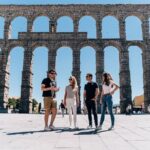
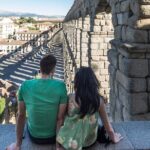
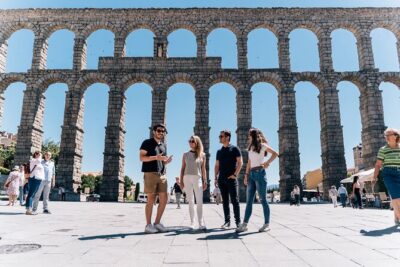
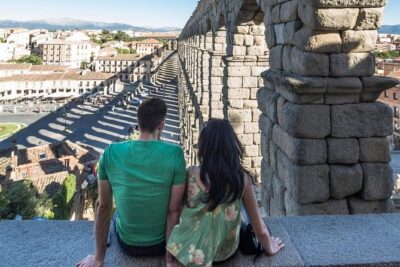
From Toledo, Segovia feels like a shift into a cleaner, more monumental world. You begin with time in the city, then you hit the Roman Aqueduct of Segovia, one of the best-preserved Roman monuments of its kind in Spain. Even if you have seen Roman ruins before, this one hits differently because it stays upright, whole, and visually loud.
The Roman aqueduct does more than look impressive. It explains how ancient infrastructure shaped the city’s growth. When you stand there, you can almost picture the water route as a daily necessity, not a distant “cool artifact.”
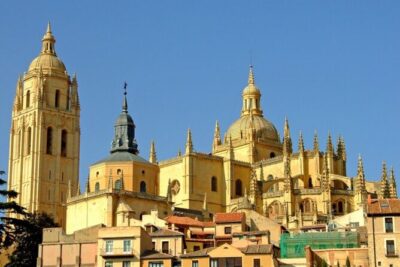
Then you move through Plaza Mayor, where you get the main square vibe and classic cathedral backdrop views. After that, you reach the Cathedral of Segovia, often referred to as the Lady among the Cathedrals of Spain. If you like gothic details, this is a good stop, because you get a chance to look up and notice how the building dominates the square.
Alcázar of Segovia: what you see, and what costs extra

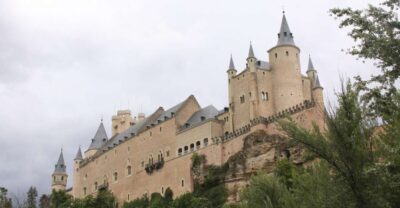
Segovia’s Alcázar sits on a hilltop, like a fortress designed for both defense and drama. Your stop here is built around admiring it and getting views from the northwest part of the city, where the fortress rises above the town.
Two practical things matter. First, the time allocation is limited, so plan on using this moment for photos and for a high-level sense of the structure. Second, the Alcázar ticket is not included, so if you want to go inside, budget for that separately.
If you are on the fence about paying for entry, here is how I think about it: if you love castles and want interior rooms, choose to pay. If your goal is seeing the silhouette and getting great exteriors, you may feel satisfied even without entry, especially in a day that already includes major sights in Toledo and Ávila.
Ávila’s walls and gates: Los Cuatro Postes and Puerta del Alcázar

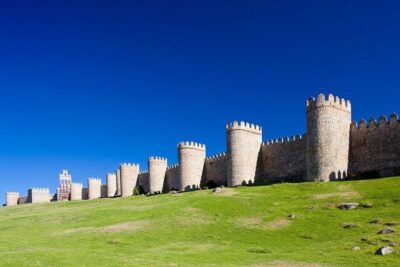
Ávila is the wall city, and the tour leans into that strength. You start with a viewpoint at Mirador de la Pradera de San Marcos to line up the view of the Alcázar. Even if you are not planning to enter the fortress, the view helps connect the city’s defenses to its layout.
Then you get Los Cuatro Postes, one of the best panoramic viewpoints for seeing the city and its walls as a whole. This is where Ávila stops being a set of buildings and becomes a fortified system.
Next, you head to Puerta del Alcázar, a monumental gate on the walls. Seeing the gate after the viewpoints is smart. You move from “this is how big it is” to “this is how it works,” with a clearer sense of where people would move in and out.
Catedral de Ávila and Las Murallas: the details behind the wow
After the gates and views, you spend time around Catedral de Ávila. The cathedral here is known as one of the most primitive gothic cathedrals of Spain, with construction beginning in the 11th century. The key point for your planning: Catedral de Ávila entry is not included, so you may just view it from outside or with limited access depending on how your guide times the stop.
Then you finish with Las Murallas de Ávila, the well-preserved wall system built beginning in the 11th century. Even if you do not do a full walk along every stretch, seeing the walls close up is a big part of why Ávila feels different. The city does not need to show you every museum piece to impress you. The walls do the job.
If you have limited energy, prioritize the viewpoint stops plus Las Murallas. That combination usually gives you the biggest payback per minute.
Price and value: is $702.14 per person fair for this much ground?
At $702.14 per person, this is not a budget day. But it is also not just “a driver takes you to places.” You are paying for a private, English-speaking guide, hotel pickup and drop-off, and a day that stitches together three UNESCO towns into one smooth schedule.
For value, think about what you would otherwise spend to replicate this:
- private transport or multiple train and taxi segments across three towns,
- paid guided time in multiple historic centers,
- and the planning hassle of coordinating start times, parking, and ticket timing.
That is where the price can start to make sense. The tour’s most praised strength is the guide quality and flexibility, including small practical adjustments like reduced walking for people who struggle with stairs and the habit of staying prompt on the schedule. If you are traveling as a couple or small family, those saved time headaches often feel like part of the “value.”
If your group loves spending hours slowly in one town, you might feel this day is packed. If you want big UNESCO hitters with guidance to keep you from missing the key points, this price can feel reasonable.
What to pack and how to handle the walking on a 10-hour loop
The tour asks for moderate physical fitness. That usually means you can do a mix of short walks and longer town time, but you should expect some uneven pavement and stairs around historic sites.
I would bring:
- good walking shoes with grip,
- a small day bag with water,
- a light layer for early and late hours,
- and a phone camera battery pack if you like photos.
If weather turns, it can still be a long day. In one group experience, umbrellas were arranged when rain came in, which is exactly the kind of comfort detail that helps. Even if you do not get umbrellas automatically, you should plan to be ready for a quick change.
Also, keep expectations on the right scale. Your stops include multiple short segments, then a few longer blocks. If you treat every minute as a moment to take in the scene instead of trying to “finish” the city, the day feels enjoyable rather than hectic.
Who should book this tour, and who might feel squeezed
Book it if:
- you want three UNESCO towns in one day from Madrid,
- you like a guided route that helps you connect the dots quickly,
- you value panoramic orientation stops like Mirador del Valle and Los Cuatro Postes,
- you are okay with a full-day schedule.
You might want a different plan if:
- you dislike long driving days,
- you need lots of time to sit and read or museum-hop,
- you strongly prefer to pay for fewer sites and linger less.
This tour can work well for families too, especially when your guide keeps the day moving and makes stops feel intentional. It has also been described as a good fit for seniors who do not do stairs well, thanks to adjustments along the way.
Should you book? My straight answer
If you have limited time in Madrid and you want to see Toledo’s layered medieval feel, Segovia’s Roman and gothic highlights, and Ávila’s walls in one day, I would book this. The biggest reason is practical: the tour is designed to reduce planning stress while still getting you the major “can’t miss” sights across three cities.
If you are the type who needs a slow pace and hates feeling rushed, consider splitting your time and doing fewer cities. For a one-day UNESCO sprint with strong guiding and smart viewpoints, this one is a solid pick.
FAQ
Do I get hotel pickup and drop-off in Madrid?
Yes. Hotel pickup is offered, and you will also be dropped back after the tour.
Is this tour private?
Yes. It is private, and only your group participates.
How long is the tour?
The duration is about 10 hours.
Is the tour offered in English?
Yes. English is offered.
Are admission tickets included for all sites?
Most stops list free admission tickets, but some places are not included. Alcázar of Segovia and Catedral de Ávila are listed as admission not included.
What if the weather is bad, or I need to cancel?
The experience requires good weather. If it is canceled due to poor weather, you will be offered a different date or a full refund. There is free cancellation, and you can cancel up to 24 hours in advance for a full refund.
A full circuit of Ávila


Aqueduct, cathedral and Alcázar

Toledo above the Tagus
Fresh ways to see Madrid
- Tour to Toledo & Madrid CitySight Seeing Tour
- 2-Day Guided Tour to Cordoba and Seville from Madrid
- Private Transfer from Madrid Airport to Madrid Hotels
- Wine Tasting and Flamenco Master Class in Madrid
- Prado Museum and Royal Palace Private Tour in Madrid
- Monastery Royal Barefoot Visit with entrance without waiting for queues
More ways into Segovia & Alcazar Day Trips
 ★ 5.0Avila & Segovia Tour with Tickets to Monuments from MadridFrom $819,762 reviews
 ★ 5.0Three Cities in One Day: Segovia, Avila and Toledo from MadridFrom $1268,402 reviews
 ★ 4.7Segovia and Toledo Tour, Alcazar, and CathedralFrom $487,797 reviews
 ★ 4.6Avila and Segovia Day Trip with Tickets to MonumentsFrom $744,568 reviews
 ★ 4.6Toledo & Segovia Full Day Guided Tour with AlcázarFrom $454,394 reviews
 ★ 4.5Avila with Walls and Segovia with Alcazar from MadridFrom $603,293 reviews
 ★ 4.3From Madrid: Segovia & Avila Day Trip with Optional TicketsFrom $592,161 reviews
 ★ 4.5Segovia and Toledo Day Tour from Madrid with Optional AlcazarFrom $771,745 reviews
Try another angle on the same itinerary