
REVIEW · MADRID
Don Quixote Quest Experience in Madrid
Madrid is better when you play. This Don Quixote Quest turns a walk into a 2-hour puzzle trail through literary Madrid and lesser-known spots.
I like that it mixes the freedom of independent exploring with the structure of prompts, so you are not wandering aimlessly. I also like that it is a private game-meets-tour just for your group, with no need to line up for a physical guide.
One thing to keep in mind: if there is construction, a few challenge instructions may lag behind real-world changes, so stay flexible.
Key highlights you will feel right away
- Offline city game so you can keep moving even with spotty phone signal
- Private for your group, great for friends, families, and small crews
- Literature-focused stops tied to Goya-era Madrid and the Golden Age writers
- Start any time, then pause and resume when you want
- Free for kids, with a built-in game feel that lowers the usual museum friction
Keep the day moving with these well-rated choices around Madrid.
- Madrid: Tour Bernabéu Entry Ticket★ 4.5 · 21,573 reviews
- Madrid: Prado Museum Entry Ticket★ 4.6 · 17,509 reviews
- Madrid: “Emociones” Live Flamenco Performance★ 4.8 · 12,866 reviews
- Madrid: Panoramic Route City Tour★ 4.1 · 12,259 reviews
How the Don Quixote Quest game works in Madrid
This is not a standard guided tour where someone talks the whole time. It is a city game that guides you using prompts on your phone, then asks you to look around and answer small challenges to move to the next location.
The big practical win is that you can play offline. The tour is built for you to download the app and then follow the prompts without needing internet while you are walking. That matters in Madrid, where you might bounce between plazas, narrow streets, and pockets of weak signal.
You also get real flexibility. You can start at any hour, take a break, and resume later. In plain terms, this means you can do it around your day. If you want a slow morning and a fun afternoon, you can. If you want to fit it between long lunch and tapas, you can do that too.
One more useful detail: there is mobile ticket access. So you are not dealing with printed vouchers or chasing paperwork while you are trying to start the game.
Price and time: value for $8.40
At $8.40 per person for about 2 hours (approx.), you are paying for three things: (1) curated walking route, (2) game prompts, and (3) a low-stress way to see Madrid without a live guide.
That is usually a good deal when you are trying to get more from fewer hours. Two hours in central Madrid can evaporate fast if you do not have a plan. The game gives you a plan, but it does not force you to go at one strict pace.
It also helps that this is private. You are not paying extra just to share a single group tour with strangers. If you are traveling with family or a tight circle of friends, a private game format can feel like the best of both worlds: structure plus your own rhythm.
And yes, there is a group discount option and it is free for kids. If your group includes younger travelers, that alone can make the math easier.
Meeting point and the route ending in Plaza de Santa Ana
You start at C. del Marqués Viudo de Pontejos, 17, Centro, 28012 Madrid. Your end point is C. del Príncipe, 2, Centro, 28012 Madrid, and the game finishes in the middle of Plaza de Sta. Ana based on the exact instructions inside the Questo.
Why this matters: Plaza de Santa Ana is one of those central spots where it is easy to keep your day going afterward. You get a natural “release valve” at the end. You can grab a snack, wander theater streets, or link up with other sights without needing to backtrack.
It is also worth noting the tour runs Monday to Saturday, from 12:00 AM to 11:59 PM during the valid period listed. In real life, it means you are not locked into a narrow time slot.


Stop by stop: Plaza Mayor and the medieval spine of Madrid
Plaza Mayor, the heart of Old Madrid
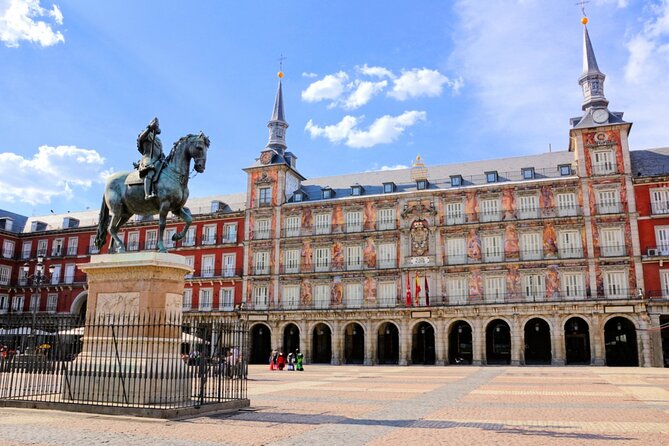
The game begins at Plaza Mayor, Madrid’s major central square. This is the classic stage for Old Madrid life, first built during the reign of Philip III. It also sits just a few blocks from Puerta del Sol, so you can easily connect other plans before or after.
Your challenge here is simple and effective: you are told to look around to find the answer and learn the story of the place before moving on. This is a smart approach because it forces your eyes onto details you would otherwise walk past, like architectural rhythm and the way the square frames the streets that feed into it.
A practical tip: Plaza Mayor is busy. So if you can, do the game at a slightly quieter hour. Even a small shift in timing can make it easier to read things and spot the clues.
Puerta Cerrada, where a medieval gate once opened
Next, you hit the complex that preserves the name Puerta Cerrada. This refers to a Christian wall gate of Madrid during the Middle Ages and the Renaissance, later demolished in 1569 during Isabel de Valois’s entry into the city, wife of Felipe II.
This stop is a good example of why the game format works. Instead of reading a long plaque, you hunt for the story through the prompts. That keeps it lively and helps the location stick in your head.
The square tied to customs, banks, and the Treasury
A plaza created in 1926 with big-city financial history
Then you move to a square created in 1926, caused by the demolition of several buildings around the old customs area and La Leña square, which later became Calle de la Bolsa. The puzzle location comes with layered Madrid history, including references to the Convent of the Trinitarios Calzados and the fish market of Almidón.
It also connects to a strong Madrid theme: old spaces that later get repurposed by power and finance. The 17th-century palace of the Five Major Guilds built by Manuel de la Ballina later became property of the Bank of Isabel II. When that bank merged, it led to the first headquarters of the Bank of Spain. Today, it houses the General Directorate of the Treasury.
Why you will enjoy this as a game stop: it is not just “look at a building.” It is “notice how the city changes roles over time.” The challenge asks you to look around and confirm the story, which helps you see the building as part of Madrid’s working life, not just a photo spot.
Iglesia de San Sebastián on Atocha Street
A 16th-century church with a devotional route
Next up is Iglesia de San Sebastián, a 16th-century church on Atocha street #39. The name comes from a devotional chapel found along the route to the Basilica of Nuestra Señora de Atocha, founded in 1541.
This is a nice change of pace because it shifts you from wide squares to a more focused landmark. It is also a good reminder that Madrid’s literary and artistic identity is tightly interwoven with religion, street routes, and city movement.
As you play, keep your eyes on the details the prompts point you to. Churches reward slow looking, and game-style looking is often faster and less exhausting than a museum crawl.
Lope de Vega’s house-museum: Golden Age writer energy
The writer’s home you can walk through
Then you reach the House-Museum of Lope de Vega, located in the former home of the Golden Age writer Lope de Vega. The 16th-century house was bought by the writer in 1610.
This stop is especially well matched to the game approach. A house-museum can feel like “one more building,” unless someone helps you connect it to everyday life. Here, the prompt-based format nudges you to look for what makes it a home, not just a label on a wall.
If you enjoy Spanish theater and literature, this part tends to feel more personal. Lope de Vega represents the big wave of Golden Age writing that shaped Madrid as a cultural capital.
Cervantes childhood home: the Don Quixote connection
Museum of Cervantes and the everyday life of the 1500s and 1600s
One of the strongest stops is Cervantes. The childhood home of Miguel de Cervantes Saavedra now houses a museum dedicated to him. It recreates customs, traditions, and everyday life of the 16th and 17th centuries.
This matters because it turns Don Quixote from an idea into a lived context. You are not just collecting facts about famous writing. You are looking at how people in that era actually lived, dressed, and moved through their city.
The museum also holds an important bibliographic collection, with editions of Cervantes’ work across different periods and languages. There is also a temporary exhibition room, plus ongoing activities like workshops for children and teenagers, conferences, plays, and musical shows.
Even though you are doing a game, this stop is likely where you will slow down the most, because there is simply more to absorb.
A very specific Cervantes story: where he was buried
After that, the game takes you to a place tied to Cervantes’ burial. Cervantes was buried at a convent in 1616. His remains were temporarily transferred elsewhere during rebuilding in 1673, then lost until forensic scientists discovered them in 2015.
This is one of those details that makes literature feel real. It is not just a biography fact. It is a reminder that Madrid’s cultural figures leave traces that can disappear, then resurface through modern research.
And as a game stop, it has a good “look for it” structure, because you are asked to find answers in the area rather than absorbing a single long monologue.
Final stretch: Plaza de Santa Ana and the writers who echo here
Calderón, Lorca, and the tapas terrace scene
The game finishes in the middle of Plaza de Sta. Ana. The final area includes monuments to Golden Age writer Pedro Calderón de la Barca and poet and playwright Federico García Lorca, plus plenty of restaurants, cafes, and tapas bars with terraces along the sides.
This is a strong ending for two reasons. First, it gives you a clear wrap-up moment, with a place that is lively even when you are not visiting any indoor attraction. Second, it ties the route together thematically: Cervantes, Lope de Vega, Calderón, Lorca. Different eras, same Madrid spirit.
If you want to keep the momentum, plan a snack right after you finish. You will be in the right mood for it.
What I think makes this tour work so well
This game-tour hits a sweet spot for modern travel. It is city sightseeing, but you steer the pace. And it uses literature as a theme, which means you are not just chasing random landmarks.
The strongest part is how the prompts force attention without feeling like homework. You do not need expert knowledge to enjoy it. You just need to look, read, and move to the next clue.
The second best part is privacy. A private group version means you can coordinate around the needs of your people, like a kid who needs a break or a friend who wants to go slower at a church doorway.
And the third best part, based on the overall rating, is discovery. The average rating is 4.2 out of 5 across 6 reviews, with praise focused on uncovering lesser-known Madrid spots. That is exactly what this kind of game is supposed to do.
Small snag to expect, especially with construction
One practical consideration is that some instructions might not stay perfectly current if there is construction in the city. The route is built to be navigable, but reality changes. If you run into a prompt that seems off, do not panic. Step back, look around the immediate area, and follow what you can see rather than what you expect.
The good news is the tour is flexible. You can pause, take a break, and resume. That makes it easier to handle minor disruptions without turning the day into frustration.
Who should book this Don Quixote Quest
This fits best if you want:
- A fun, interactive activity for families and friends to do together
- A first or second-day Madrid plan that helps you orient yourself fast
- A low-pressure alternative to a “sit and listen” guide format
It can also work well for residents, not just visitors, because you are walking through well-known literary sites while still getting nudged toward corners and stories you might miss on your own.
If you hate scavenger-style tasks, you might find the looking-and-answering challenges a bit distracting. But the overall feel is light and built for general participation.
Should you book this quest game in Madrid?
Book it if you want a 2-hour literary walk that feels playful, not rigid. The price is low enough that you can treat it as a smart add-on, and the offline game format helps you keep control of your schedule.
Skip it if you need a traditional human guide or you dislike phone-based prompts. Also, if your travel dates overlap with heavy construction around central streets, go in with patience and expect that one or two prompts might need a quick workaround.
If you are traveling with kids, this is a standout value because it is free for kids and built as a game rather than a lecture.
FAQ
How much does Don Quixote Quest cost?
It costs $8.40 per person.
How long does the game take?
The experience takes about 2 hours. You can take your time, and you can pause and resume.
Do I need an internet connection to play?
No. You can play offline, so you do not need internet connection during the game.
Is this a guided tour with a physical guide?
No physical tour guide is included. It is a private game-meets-tour experience using prompts in the app.
Where does it start and where does it end?
It starts at C. del Marqués Viudo de Pontejos, 17, Centro, 28012 Madrid. It ends in the middle of Plaza de Sta. Ana, using instructions inside the Questo.
Is it private, or do I join a group?
It is private. Only your group participates.
Can I cancel for free?
Yes. You can cancel for a full refund if you cancel at least 24 hours before the experience’s start time. If you cancel less than 24 hours before, the amount paid is not refunded.
More Tour Reviews in Madrid



Fresh ways to see Madrid
- Tour to Toledo & Madrid CitySight Seeing Tour
- 2-Day Guided Tour to Cordoba and Seville from Madrid
- Private Transfer from Madrid Airport to Madrid Hotels
- Wine Tasting and Flamenco Master Class in Madrid
- Prado Museum and Royal Palace Private Tour in Madrid
- Monastery Royal Barefoot Visit with entrance without waiting for queues